Legal opinion

Fourth Debate: Doctrinal Challenges of the Law on the Defense of the Democratic Rule of Law

Fourth Debate: Doctrinal Challenges of the Law on the Defense of the Democratic Rule of Law

At a time of profound institutional tension, when the Supreme Federal Court faces unprecedented questioning regarding its legitimacy, independence, and ethical conduct, this collective work brings together legal scholars, professors, and criminal defense attorneys from across Brazil for a necessary and rigorous debate committed to the values ​​of the democratic rule of law.

Beyond causality and intent

Beyond causality and intent

This article aims to demonstrate how the theory of objective imputation of results enriches this examination, as well as to suggest ways of its application.

More essays

The series of crimes in the indictment against Bolsonaro – part 2

This article is a continuation of the discussion on the topic of multiple offenses in the context of the charges against former President Jair Bolsonaro. In this second text, Raquel examines possible connections between the crime of aggravated damage and the crime of deterioration of listed heritage sites.

The concept of miscarriage of justice in Brazilian Law

This article is an adapted version of an opinion piece that discusses the concept of judicial error and wrongful conviction in Brazilian criminal law, as well as the criteria for its compensation. It also addresses a procedural issue concerning the possibility of the Superior Court of Justice reviewing the topic.

Instant crime and permanent crime

Published in Journal of the Postgraduate Program in Law/UFRGS, v. 17. A proposal draft for distinction and limitation from the devaluation of the conduct. Crime.

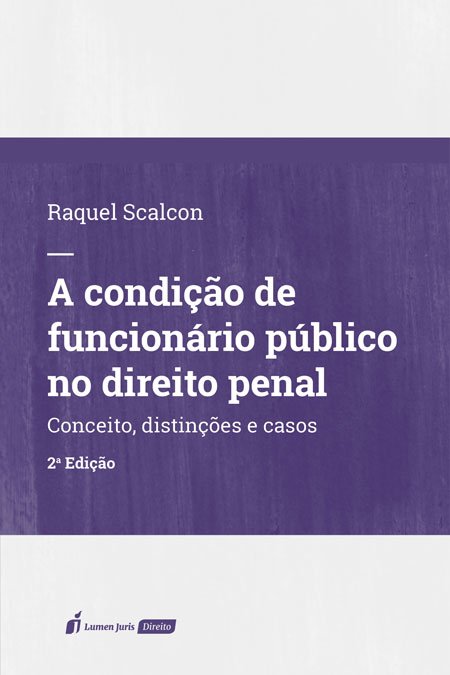
The status of public official in Criminal Law – 2nd Edition

The status of public official in Criminal Law – 2nd Edition

Concept, distinctions and cases. The numerous concrete cases discussed in this work demonstrate that the interpretation of Article 327 of the Brazilian Penal Code—which defines the status of a “public official” for criminal law purposes—is far from self-evident.