Publications

Fourth Debate: Doctrinal Challenges of the Law on the Defense of the Democratic Rule of Law
At a time of profound institutional tension, when the Supreme Federal Court faces unprecedented questioning regarding its legitimacy, independence, and ethical conduct, this collective work brings together legal scholars, professors, and criminal defense attorneys from across Brazil for a necessary and rigorous debate committed to the values of the democratic rule of law.
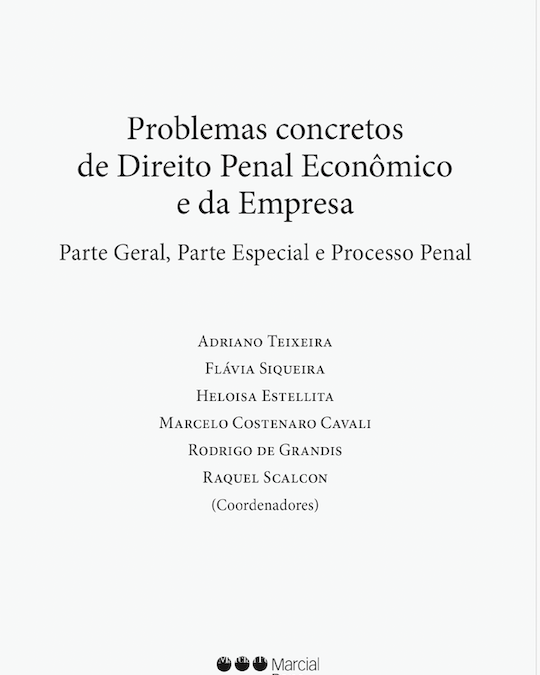
Concrete problems of economic and corporate criminal law
“Concrete problems of economic and corporate criminal law” featuring new articles addressing topics from the General Part, Special Part, and Criminal Procedure.

The public official by equivalence in Brazilian criminal law
The article is an adapted version of a legal opinion discussing the interpretation of the expression “typical activity of public administration”, present in Article 327, § 1, final part, of the Penal Code.
Beyond causality and intent
This article aims to demonstrate how the theory of objective imputation of results enriches this examination, as well as to suggest ways of its application.

Interpretive challenges of crimes against democratic institutions
The crimes outlined in articles 359-M and 359-L of the Penal Code, as analyzed by Raquel Scalcon, reveal essential interpretative challenges to the protection of democratic institutions.
Essays by Topics
More publications
The series of crimes in the indictment against Bolsonaro – part 2
This article is a continuation of the discussion on the topic of multiple offenses in the context of the charges against former President Jair Bolsonaro. In this second text, Raquel examines possible connections between the crime of aggravated damage and the crime of deterioration of listed heritage sites.
The problem of multiple offenses in the indictment against Bolsonaro (and others)
Raquel Scalcon’s article addresses the complex issue of multiple offenses in the context of the charges against Bolsonaro and others.
Between the absolute presumption of knowledge of the Law and the particularities of Economic Criminal Law
Discussions surrounding the error of prohibition, since its inclusion in the Penal Code in 1984.
Objective imputation and the “Ride Pillion Case”
The article examines the relevance of the theory of objective imputation in resolving concrete cases.
Scope and limits of the crimes of passive and active corruption
In corruption crimes, the status of being a public official serves as the “gateway” to the criminal protection of the Public Administration, shielding it from both internal and external attacks.