Between passive corruption, active corruption, and extortion

A brief analysis of the recent criminal court decision in São Paulo.

Authors: Raquel Lima Scalcon and Maria Paes Barreto de Araujo.
Year: 2020

Synopsis:

This article analyzes a recent decision by a criminal court in São Paulo in light of the distinctions and intersections between the crimes of passive corruption, active corruption, and extortion in Brazilian Criminal Law. Based on this decision, the authors discuss how jurisprudence has addressed the classification of these behaviors, considering the core verbs of each type of crime and their respective objective and subjective elements. The text also reflects on typification, the function of the principle of legality, and the challenge of adequately differentiating the behaviors in specific cases—especially given the similarity between the typical behaviors and the importance of precise criteria for proper criminal subsumption.

How to quote:

SCALCON, Raquel Lima; ARAÚJO, Maria Paes Barreto de. Between passive corruption, active corruption, and extortion. A brief analysis of the recent criminal court decision in São Paulo. In: JOTA, 2020.

More Essays

Beyond causality and intent

Beyond causality and intent

This article aims to demonstrate how the theory of objective imputation of results enriches this examination, as well as to suggest ways of its application.

Interpretive challenges of crimes against democratic institutions

The series of crimes in the indictment against Bolsonaro – part 2

This article is a continuation of the discussion on the topic of multiple offenses in the context of the charges against former President Jair Bolsonaro. In this second text, Raquel examines possible connections between the crime of aggravated damage and the crime of deterioration of listed heritage sites.

The concept of miscarriage of justice in Brazilian Law

The concept of miscarriage of justice in Brazilian Law

This article is an adapted version of an opinion piece that discusses the concept of judicial error and wrongful conviction in Brazilian criminal law, as well as the criteria for its compensation. It also addresses a procedural issue concerning the possibility of the Superior Court of Justice reviewing the topic.

Essays by Topics

Books

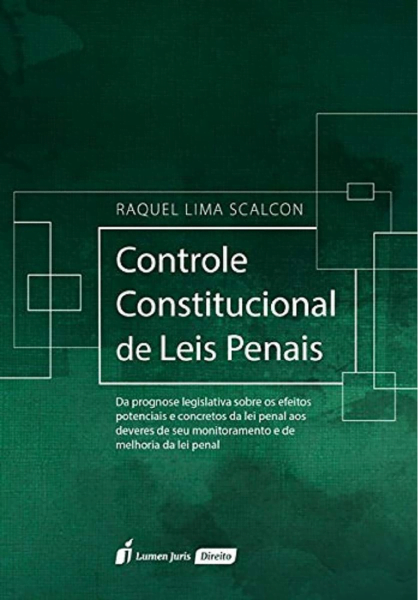
Constitutional Control of Criminal Laws

Constitutional Control of Criminal Laws

From legislative forecasts on the potential and concrete effects of criminal law to the duties of monitoring and improving criminal law. Constitutional Law.

Illegality and Punishment

Illegality and Punishment

Opposing models for the foundation of contemporary Criminal Law. The importance of the notions of unlawfulness and punishment. Claus Rozin and José de Faria Costa.